
Categories
Buyer's Guide, Market Trends & InsightsPublished October 23, 2026
What Is Mortgage Pre-Approval? A North Metro Buyer's Guide


What Is Mortgage Pre-Approval? A North Metro Buyer's Guide
Quick answer: A mortgage pre-approval is a lender's written, preliminary assessment of how much you may be able to borrow, based on a review of your financial information. It isn't a final loan commitment, but it gives you a realistic price range and shows sellers you're prepared. If you're planning to buy in Anoka, Sherburne, Wright, or Isanti County, it's the first step to take, before you start touring homes.
What does pre-approval actually mean?
When you get pre-approved, a lender looks at your credit, income, debts, and assets and tells you, in writing, roughly how much they may be willing to lend. The Consumer Financial Protection Bureau (CFPB) is clear that these letters are useful but are not guaranteed loan offers. They rest on certain assumptions, and the final loan still depends on things like the property itself and full underwriting.
Think of it as a well-informed starting point. It answers "what can I realistically shop for?" long before you're sitting across from a seller.
Pre-approval vs. pre-qualification: what's the difference?
You'll hear both terms, and they're often used interchangeably. According to the CFPB, lenders don't use them consistently: some offer a pre-qualification letter based on information you simply report, and save the word "pre-approval" for a letter based on information they've verified.
The practical takeaway: don't rely on the label. Ask your lender, "What is this letter based on?" A letter built on verified documents generally carries more weight with sellers than one built on a quick conversation.
Why pre-approval matters before you shop
It sets a realistic price range. Knowing your numbers keeps you from falling for homes outside your range, or from underestimating what you can actually afford. Remember that the monthly payment includes more than principal and interest. Our guide to the real cost of buying a home in Minnesota breaks down the rest.
It clarifies your financing. A good lender conversation covers loan types, down payment options, and whether a program fits your situation. For example, Minnesota Housing's Start Up and Step Up programs are offered through participating lenders, and when all borrowers are first-time buyers, at least one must complete an approved homebuyer education course before closing. If you think you might use one, choose a lender who participates. Our article on down payment requirements goes deeper.
It prepares you to make an offer. When the right home appears, you don't want to be scrambling for paperwork. Having your pre-approval ready lets you move quickly and confidently. We cover what happens next in making an offer in a competitive Minnesota market, and what to expect after it's accepted in our earnest money guide.
It surfaces problems early. If something on your credit report or in your debt picture needs attention, you'd rather find out now, with time to address it, than in the middle of a contract.
What lenders typically ask for
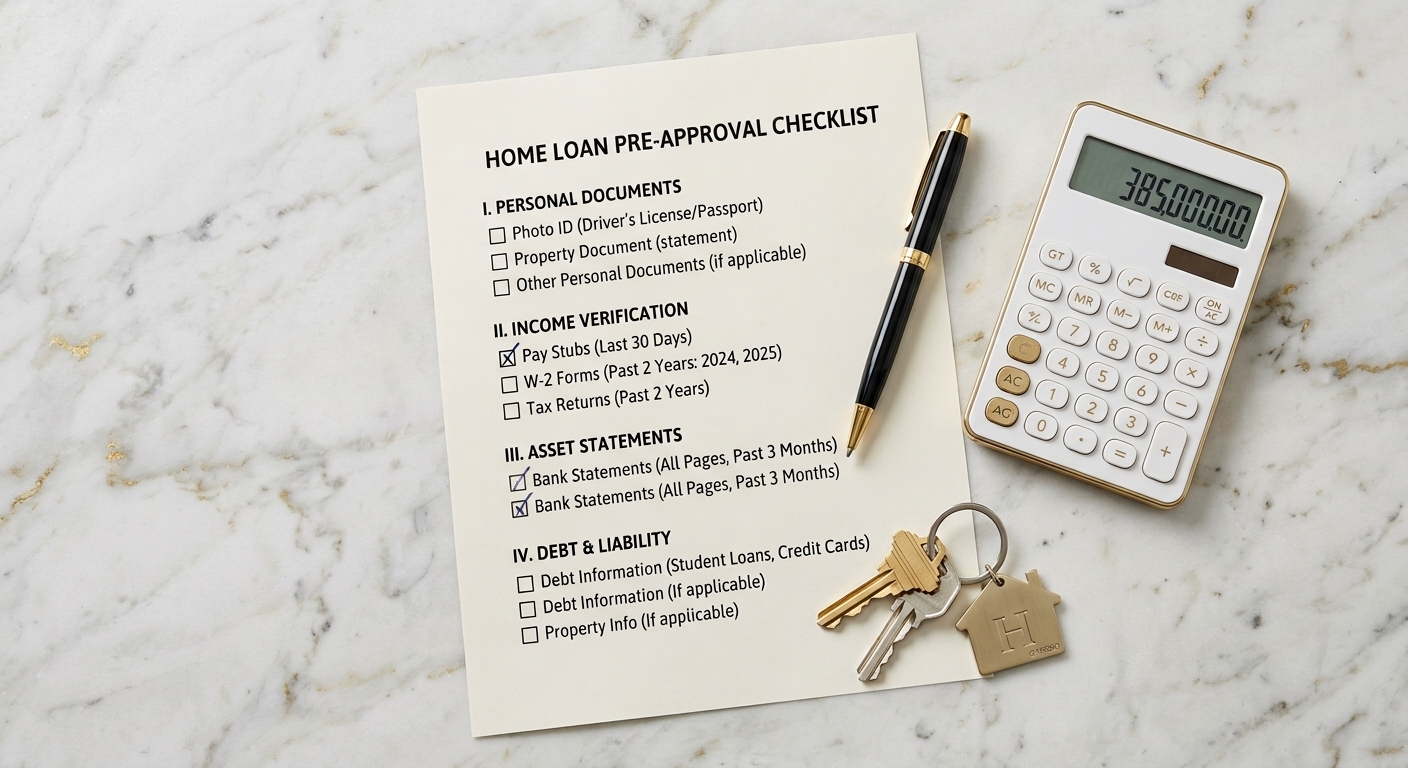 Documents and checklist for getting pre-approved for a mortgage
Every lender has its own checklist, so ask for yours. In general, expect requests for:
- Recent pay stubs and W-2s or tax returns
- Bank and asset statements
- Employment history
- Information about your current debts
- Government-issued ID and authorization for a credit check
Self-employed buyers and buyers with variable income are often asked for more documentation, so start gathering early.
How to get pre-approved: a simple process
- Talk to more than one lender. Rates, fees, programs, and communication style differ. Compare them.
- Gather your documents before you apply so the process moves quickly.
- Complete the application and credit check. Ask the lender how their process affects your credit.
- Review the letter carefully. Confirm the loan amount, loan type, and any conditions attached.
- Keep your finances steady while you shop.
Mistakes to avoid
- Treating your maximum approval as your budget. What a lender will approve and what feels comfortable month to month can be very different numbers.
- Waiting until you've found a home. Pre-approval first, showings second.
- Making big financial changes mid-process. A new car loan, new credit cards, or a job change can affect your financing. Tell your lender before making any major move.
- Assuming pre-approval is a guarantee. The home must still appraise, pass underwriting, and meet the lender's requirements.
Does the type of property matter in the north metro?
It can. A suburban home in a city like Ramsey or Otsego is a different financing conversation than a rural property with acreage, a private well, and a septic system. If you're considering acreage, new construction, or land, tell your lender early what you have in mind so there are no surprises on timing or loan options.
How long does a pre-approval last?
It varies by lender, and letters typically carry an expiration date. Ask when yours expires and what would be needed to renew or update it, especially if your search stretches on or your financial situation changes.
Your next step
Pre-approval is the first move, but it works best alongside a local agent who knows what the numbers look like on the ground. If you're getting ready to buy in the north metro, start here with DeGreeff & Associates and we'll talk through your timeline, your budget, and how to get started.
This article is general information, not financial, tax, or legal advice. Talk with a licensed lender about your specific situation.

Steven DeGreeff
Owner / Realtor® | Degreeff and Associates | Steven DeGreeff | Keller Williams Realty Integrity NW
or another way