
Categories
Seller's Guide, SellerPublished November 17, 2026
Can You Appeal Your Property Taxes in Minnesota? What North Metro Homeowners Should Know


Can You Appeal Your Property Taxes in Minnesota? What North Metro Homeowners Should Know
Short answer: Yes, with one important distinction. In Minnesota you can't appeal the tax rate or your local governments' budgets. You can appeal the two things the assessor decides: your home's estimated market value and its classification. If either is wrong, your share of the tax bill is wrong too. The key is acting during the right window, which opens with the valuation notice that arrives each spring.
Many homeowners assume the number on their property tax statement is final. It isn't. Here's how the system works, when you can question it, and how to make a case that holds up.
What You Can (and Can't) Appeal
Your property tax is shaped by three things:
- How much your local governments spend. Your county, city or township, school district, and other taxing districts set levies to fund their budgets.
- Your property's estimated market value. This is the assessor's estimate of what your home would sell for.
- Your property's classification. For example, a homestead is taxed differently than a rental or a cabin.
Value and classification can be appealed. Budgets and levies can't, but they can be influenced at the public meetings held each December (more on that below).
Which Notice Opens the Appeal Window?
Minnesota homeowners get three property tax mailings a year. The timing confuses a lot of people:
- Valuation notice (March–April): Shows your value and classification for taxes payable the following year. A 2027 valuation notice, for example, shows "2027 values for taxes payable in 2028." This is the notice to act on. It lists your appeal meeting dates.
- Proposed tax notice (mid-November): The Truth-in-Taxation notice estimates next year's taxes and lists budget meeting dates.
- Property tax statement (March): The actual bill for the current year.
The problem: by the time a bill surprises you, the board deadlines for that value have usually passed. That's why the valuation notice deserves a closer read than most people give it.
Reasons to Question Your Assessment
An appeal makes sense when you have a specific, provable reason, not just a tax bill that went up. Common ones:
- Recent sales of comparable homes nearby are lower than your estimated market value.
- The county's data is wrong: finished square footage, number of bedrooms or bathrooms, a basement listed as finished when it isn't, or a garage or outbuilding that's been removed.
- Condition issues the assessor may not know about, such as a failing foundation, water damage, or an original roof and mechanicals.
- The classification is wrong, such as a home you live in that isn't receiving homestead classification.
- Rural property details, including acreage, wetland or other non-buildable land, and outbuildings, especially on larger parcels in Sherburne, Wright, and Isanti counties.
How the Appeal Process Works
Step 1: Call the assessor. The contact information is on your valuation notice. Anoka County notes that most questions are resolved through this informal review. Ask how your value was set and which sales were used. Assessors may ask to inspect the property. If you refuse an inspection, the local and county boards can't change your value in your favor.
Step 2: Open Book or Local Board (April–May). Your city or township decides which format applies, and your valuation notice tells you. Some cities hold Open Book meetings, which are informal reviews with assessor staff. Others hold a Local Board of Appeal and Equalization, usually made up of city council or township board members. In Sherburne County, many townships hold their own Local Board. Big Lake Township, for example, met in April 2026 with the county assessor present. If your city or township holds a Local Board, you must appear there before you can go to the County Board. In Open Book cities, you can go straight to the County Board. Schedule your appearance ahead of time.
Step 3: County Board of Appeal and Equalization (June). If the earlier step doesn't resolve things, you can bring your case to the County Board, which meets in June. The exact date is on your notice.
Step 4: Minnesota Tax Court. You can skip the boards and petition the Tax Court directly, or go there after them. The deadline is April 30 of the year the taxes are payable. Filing fees are $150 for the Small Claims Division and $310 for the Regular Division, plus a local law library fee. Small Claims is open in certain cases, such as homes with an estimated market value under $300,000 or a denied homestead classification. Its decisions are final and can't be appealed.
(Be sure to confirm the Tax Court fee amounts and Small Claims eligibility criteria in your area)
What to Bring
Minnesota law presumes the assessor's value is correct, so the burden is on you to show it isn't. Useful evidence includes:
- A recent appraisal of your property.
- Recent sales of similar homes in your area, not active listing prices alone. Anoka County publishes a residential sales tool showing the sales used in its assessment.
- Photos and repair estimates for condition problems.
- Documentation of incorrect data, such as a floor plan, permits, or proof an outbuilding was removed.
- Proof of use, if you're appealing classification.
Assessments are mass appraisals built on sales from a set period, generally October through September of the prior year. Compare your home to sales from that same window.
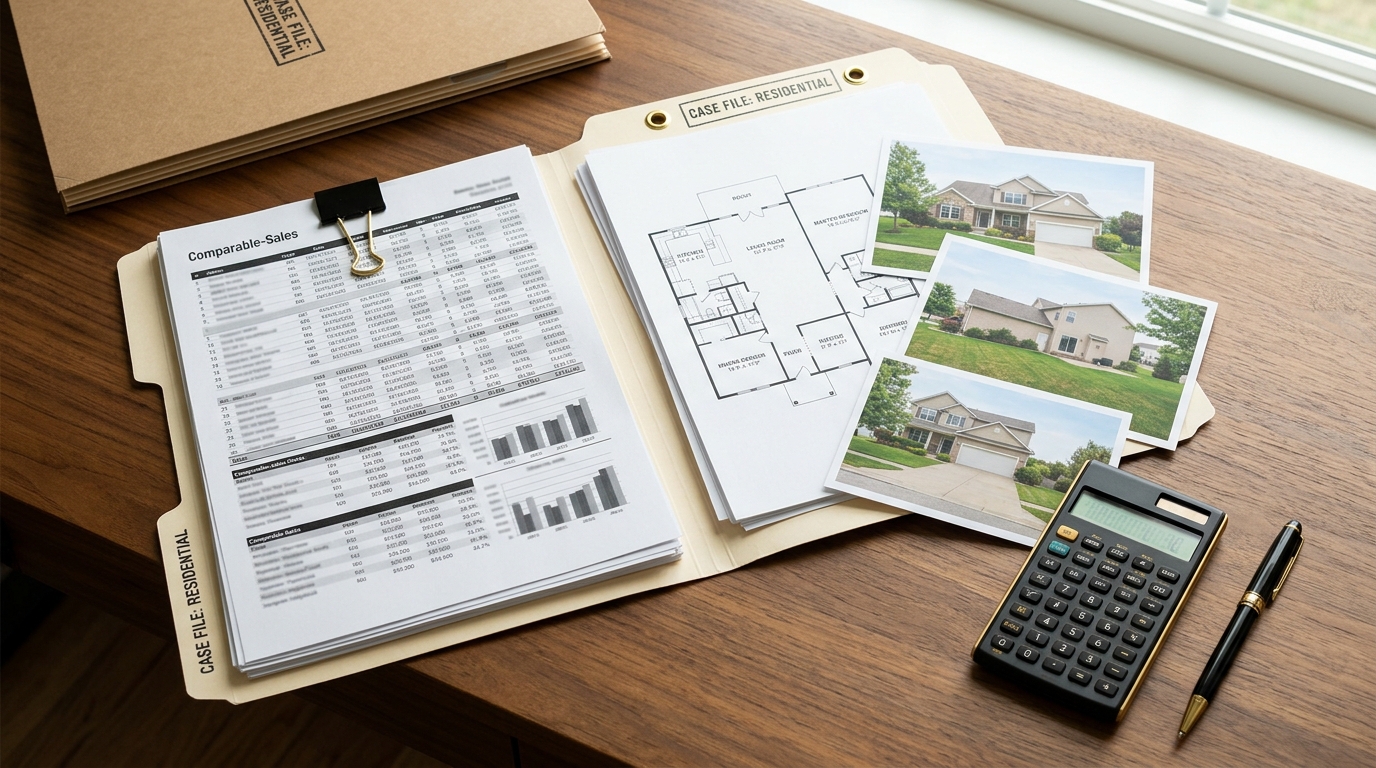
Comparable sales and corrected property data make the strongest case.
What an Appeal Won't Do
A lower value doesn't automatically mean an equally lower tax bill, because taxes are spread across every property in a taxing district. And your estimated market value isn't a list price. Sellers sometimes assume a home will sell for its assessed value, or that a high assessment means a high sale price. Assessors work from mass data. Pricing a home for sale depends on current comparable sales, condition, and what buyers are paying right now.
Just Got Your Proposed Tax Notice? (November 2026)
Truth-in-Taxation notices arrive between November 10 and 24. Taxing districts then hold public budget meetings after November 24. Those meetings are the place to weigh in on spending. They don't hear value appeals.
If you think the value behind your proposed 2027 taxes is wrong, the local and county boards for that assessment have already met. The Minnesota Tax Court route stays open until April 30, 2027. Your next valuation notice, for taxes payable in 2028, will arrive in spring 2027 and open a new round of board meetings.
Know What Your Home Is Actually Worth
Property taxes aren't set in stone, but a good appeal starts with good information. A comparable-sales analysis from someone who tracks your local market can show whether your assessment lines up with what similar north metro homes are actually selling for.
Get a home value analysis for your north metro home →
This article is general information, not legal or tax advice. Appeal procedures, dates, and fees vary by jurisdiction and change over time; check your valuation notice and contact your county assessor.

Steven DeGreeff
Owner / Realtor® | Degreeff and Associates | Steven DeGreeff | Keller Williams Realty Integrity NW
or another way